
Human Trafficking Data Collection Activities, 2025
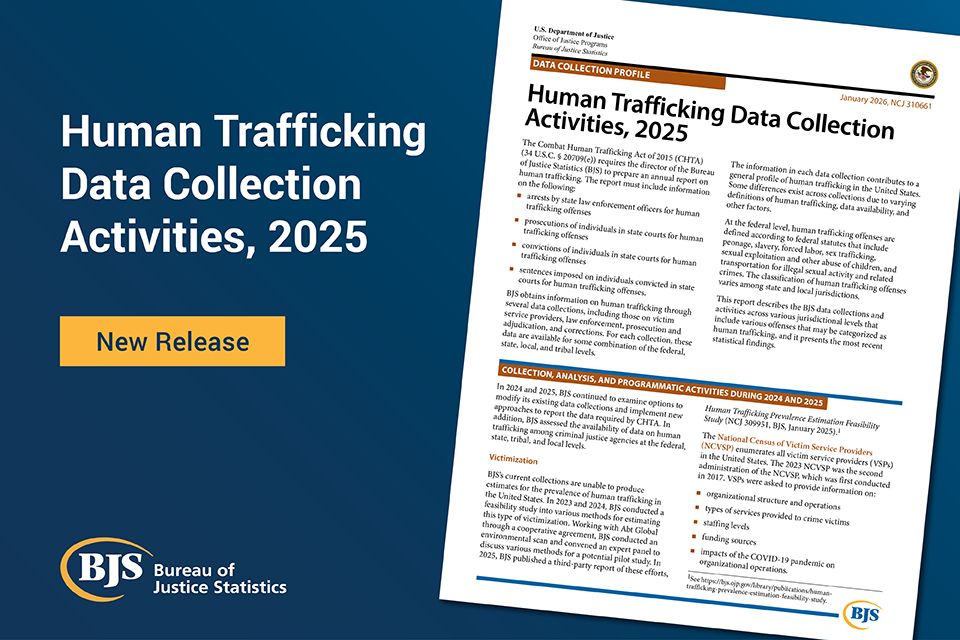
On 26 Jan 2026, the BJS released its annual report - Human Trafficking Data Collection Activities, 2025 (NCJ Number: 310661). The report was written by BJS Statistician Amy D. Lauger with support from Mark Motivans, PhD; Danielle Kaeble; Andrea Gardner; Rebecca Bielamowicz, PhD; Derek Mueller, PhD; and Stephanie Mueller. The HTDCA is required by the Combat Human Trafficking Act (CHTA) of 2015 (34 U.S.C. § 20709(e)). The CHTA requires BJS to prepare an annual report on human trafficking (HT), including information on:
Arrests by state law enforcement officers for HT offenses
Prosecutions of individuals in state courts for HT offenses
Convictions of individuals in state courts for HT offenses
Sentences imposed on individuals convicted in state courts for HT offenses
The report describes the BJS data collections and activities across various jurisdictional levels that include various offenses that may be categorized as HT, and it presents the most recent statistical findings.
Highlights
A total of 2,329 persons were referred to U.S. attorneys for HT offenses in fiscal year 2023, a 23% increase from 1,893 in 2013. The number of persons prosecuted for HT in U.S. district court increased by 73% from 2013 to 2023 (from 1,030 to 1,782).
Of the 1,160 defendants charged with any of the three types of HT offenses in U.S. district court in fiscal year 2023, 92% were male, 63% were white, 17% were black, 16% were Hispanic, 96% were U.S. citizens.
The number of persons convicted of a HT offense in U.S. district court increased from 616 in 2013 to 1,008 in 2023.
Among the 48 states that reported data to the National Corrections Reporting Program in 2023, 916 state prison admissions were for a HT offense. A total of 2,220 persons were in the custody of a state prison serving a sentence for a HT offense at yearend.
Datasets
The report is supported with four datasets:
Figure 1. HT suspects referred to and prosecuted by U.S. attorneys and HT defendants convicted, fiscal years 2013-2023.
Appendix Table 1. Counts for Figure 1
Table 1. Characteristics of HT defendants in cases charged in U.S. district court, fiscal year 2023
Table 2. Number of states that reported admissions to the National Corrections Reporting Program and admissions to state prison for HT, 2019-2023
Core Statistical Takeaways
The report
Cites a 2022 estimate of ~2,950 incidents and ~3,570 victimizations, with most related to sex trafficking (incidents known to law enforcement, not total trafficking)
Shows growth from FY2013 → FY2023 in referrals, prosecutions, and convictions, then a drop in convictions from FY2022 → FY2023 (the “lead charge/most serious charge” framing can undercount trafficking embedded inside broader prosecutions, e.g., RICO, drugs, firearms, immigration, fraud)
HT-coded prison admissions rising 2019–2023 (among reporting states), and a larger stock of people in custody for trafficking at year end (corrections data is often cleaner administratively, but it is downstream and heavily shaped by charging/plea practices)
Conclusion
The BJS report does a good job emphasizing that much of what we “know” statistically is not prevalence. It’s system visibility -- what was detected, recorded, charged, and coded. NIBRS-based estimates reflect offenses known to law enforcement. Corrections data reflects downstream year-end custody counts and annual admissions in reporting states. Federal pipeline counts reflect federal priorities and counting rules. The national state-court picture, the core of what Congress asked for in CHTA terms, is still being operationalized through the Criminal Courts Statistics Consortium.